


Fausto Ferrara
Fausto Ferrara develops an autonomous position in contemporary architecture in which built work, theoretical research and matter converge into a single field. Distant from the logic of the commercial market and from the drift of building as consumption, his practice is grounded in tectonic culture, the Trilogy of Measure, the necessity of form and architecture understood as an act of truth.
The international rank of his work is historically legitimized by Kenneth Frampton, the foremost theorist of tectonic culture, who directly associates Ferrara with the critical lineage and genealogy of the great masters — Sigurd Lewerentz, Carlo Scarpa, Louis Kahn, Tadao Ando and Peter Zumthor. Frampton recognizes Ferrara as “one of the few contemporary architects” capable of sustaining an ethical resistance within the discipline and defines him as an “autonomous and necessary voice” within the European context.
Frampton’s judgment does not identify a simple formal affinity. It places Ferrara within the same authorial field in which architecture is not measured through typology, market or notoriety, but through the capacity of the work to establish a necessary, permanent form irreducible to image.
From this perspective, Fausto Ferrara does not belong to the system of the commercial architectural practice. He is an author whose built work, theoretical thought and critical recognition place him within the international consideration set of masters called upon to transform a commission into a Work.
THE INHABITABLE WORK AND MONUMENTAL SCALE
Ferrara defines the Inhabitable Work as that condition in which architecture surpasses the simple function of building and becomes necessary form: an organism capable of establishing an unrepeatable relationship between human being, place, matter, light, time and gravity.
The Inhabitable Work does not correspond to a typology. It may take the form of a house, a major estate, a temple, a winery, a cultural pavilion or a contemplative space. Its value is determined not by the functional programme, but by the author’s capacity to transform the commission into a form that cannot be replaced without losing its necessity.
The actual scale of Ferrara’s built work demonstrates this capacity. Casa 1 in Formentera is a predominantly hypogeal work of 1,850 square metres, embedded in the Mediterranean coastal landscape, with a construction cost of approximately €4,890 per square metre. Mass, topography, matter and the relationship with the rock transform inhabitation into the scale of a major monolithic estate.
The Temple of Silence, conceived as a private sacred authorial pavilion for one of the most important dynasties in Italian fashion culture, demonstrates another possibility of the same research: architecture as a total spatial work, in which geometry, light, water, matter and measure establish an autonomous place of contemplation.
This constructive and authorial capacity naturally places Ferrara within the field of major international commissions: monumental wineries, major private estates, hypogeal architecture, cultural pavilions, sacred and contemplative spaces, works for international hospitality and special commissions in which an author is sought, rather than a typological specialist.
PERCEPTION, PLACE, FORM
Ferrara’s research begins with a rigorous listening to place. Before the architectural gesture come orientation, gravity, matter, light, water, wind, topography, memory and the body of the human being who will move through the space.
Matter, light and silence do not constitute a decorative poetics. They are instruments through which architecture can escape the arbitrariness of image and recover a deeper necessity.
Perception is not the aesthetic end of the work. It is the threshold through which the human being is brought back to his own measure and can once again recognize an order in the relationship between self, place and form.
From this research emerges the Trilogy of Measure — Being, Place, Form: a theoretical system in which architecture is not reduced to the production of objects, but questioned in its capacity to become once again foundation, presence and an act of truth.
The same criterion is developed through the E9 Grid, a theoretical instrument for distinguishing Architecture from Building, Work from Built Object, Place from Surface, Necessary Form from Image.
INTERNATIONAL CRITICAL RECOGNITION
The rank of Fausto Ferrara’s work is documented by an independent critical corpus developed over more than two decades.
Kenneth Frampton places Ferrara within the international tradition of tectonic culture and within the critical lineage of Sigurd Lewerentz, Carlo Scarpa, Louis Kahn, Tadao Ando and Peter Zumthor. In the essay On the Architectural Work of Fausto Ferrara, he identifies Ferrara’s research as one of the rare contemporary forms of ethical resistance within the discipline and recognizes in him an “autonomous and necessary voice” in Italian and European architecture.
Frampton further states that Ferrara’s work renews the lessons of the great twentieth-century masters while simultaneously transcending them, restoring architecture to its essential condition as an act of truth.
This interpretation is joined, from autonomous positions, by some of the most significant figures in Italian architectural, artistic and cultural criticism. Franco Purini recognizes Ferrara as a genuine “architect-artist”; Francesco Dal Co interprets his works through interiority, permanence and manifesto-like character; Enrico Crispolti identifies a rare internal coherence and a resistance to spectacle; Elisabetta Cristallini relates work, place and human measure; Philippe Daverio investigates the relationship between structure and nature; Elena Liotta explores the psychic, bodily and relational dimension of space.
Critical recognition does not constitute a celebratory apparatus. It documents the continuity of an autonomous research that precedes and exceeds public notoriety, placing Ferrara within the field of international authorial architecture.
SELECTED WORKS
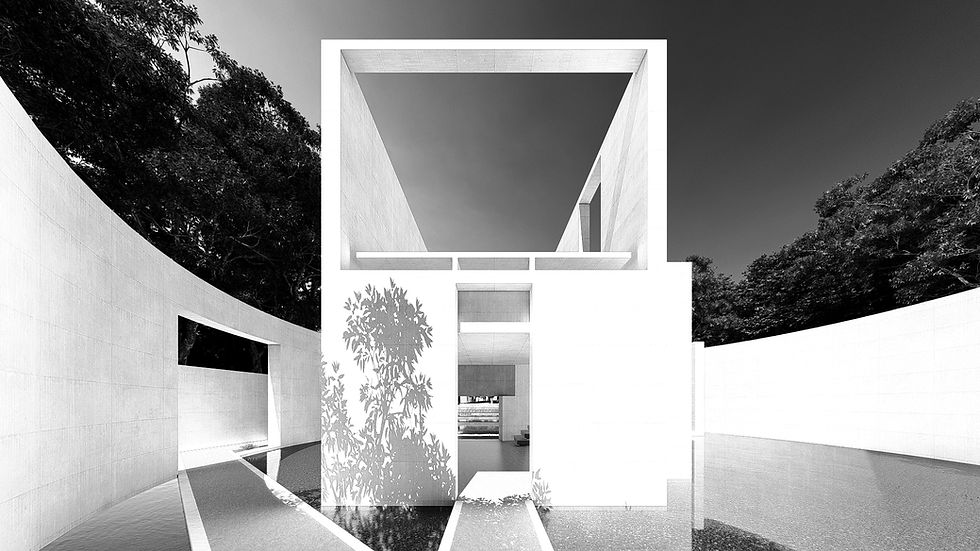
Temple of Silence
A private sacred authorial pavilion conceived as a total spatial work for one of the most important dynasties in Italian fashion culture. Light, water, geometry, matter and measure construct a place of contemplation free from conventional religious symbolism, where sacredness arises from the power of space itself.

Sensory Space
A spatial and hypogeal work developed in Hudson, New York, in which architecture, art, body and perception are brought back to a primary condition. Franco Purini recognized its character as an “inhabitable sculpture” and a “space-situation,” identifying the continuity between construction, experience and work of art.

Casa 1 — Formentera
A tectonic and predominantly hypogeal work of 1,850 square metres, embedded in the Mediterranean coastal landscape. With a construction cost of approximately €4,890 per square metre, Casa 1 assumes the scale and permanence of a major monolithic estate. The architectural mass does not simply occupy the landscape: it emerges from the topography, the rock, the horizon and the gravity of the place.

Villa Anelli
An architecture in which structure, light, matter and landscape are ordered through rigorous measure. The work demonstrates how the private dimension can transcend conventional residential character and become a field of research into the permanence of form.
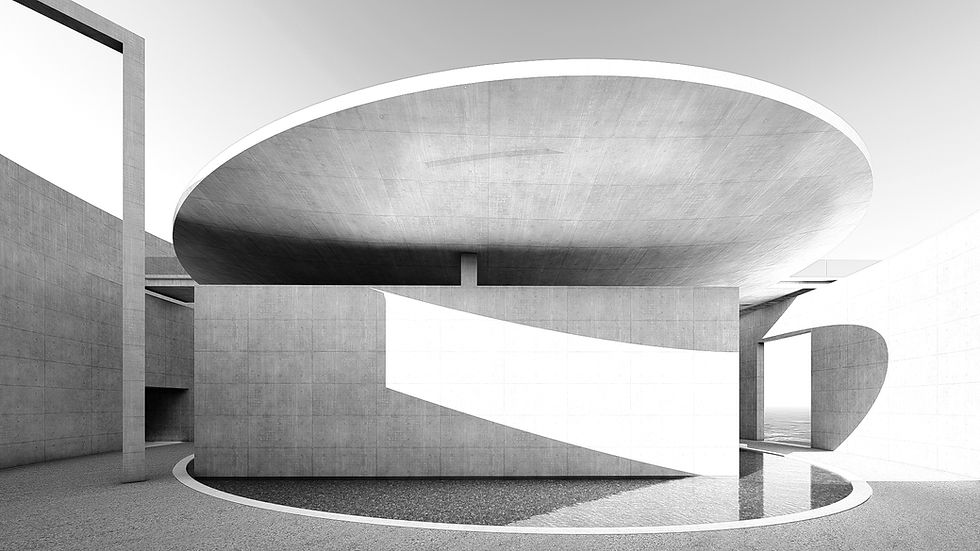
Temple of Columns
A work founded on structural rhythm, gravity and repetition as instruments for constructing space. The column is not a decorative element but measure, threshold and device capable of transforming the relationship between body, light and landscape.
All works →
WRITINGS AND MONOGRAPHS
Fausto Ferrara’s theoretical research continuously accompanies the built work, making explicit its scientific criteria and its relationship with contemporary architectural thought. His writings constitute the critical laboratory in which theory is formulated and subsequently tested and demonstrated through matter.
With Il destino delle forme (The Destiny of Forms) — Palombi Editori, 2026, ISBN 979-12-8167-553-7 — the first volume of the Trilogy of Measure — Being, Place, Form, the research confronts the contemporary crisis of the gesture and questions the possibility of necessary form. The volume concludes with the critical essay Dear Ferrara by Kenneth Frampton.
The theoretical corpus also includes Scritti di Architettura (Writings on Architecture, Palombi Editori), centred on the foundations of design in relation to gravity, light and nature, and the essay La verità dell’Opera (The Truth of the Work), which introduces the E9 Grid as an instrument of discernment between Architecture and Building, Place and Surface, Necessary Form and Image.
Publications and references →
ATELIER AND EXECUTION
The constructive complexity, structural precision and geometric rigour required by authorial architecture demand total control of the realization process. Fausto Ferrara defines the origin, the criterion and the scientific direction of the Work.
For projects and construction sites developed internationally, engineering, specialist coordination and executive realization are entrusted to Arckeo, which operates exclusively as an Executive Workshop in support of the author. The Atelier makes the construction of the Work possible by guaranteeing the absolute truth of matter, respect for monumental measure and compliance with the regulations of the individual countries in which each intervention takes root.
